
Level 1 · How water moves around a house
From the street to your stop tap
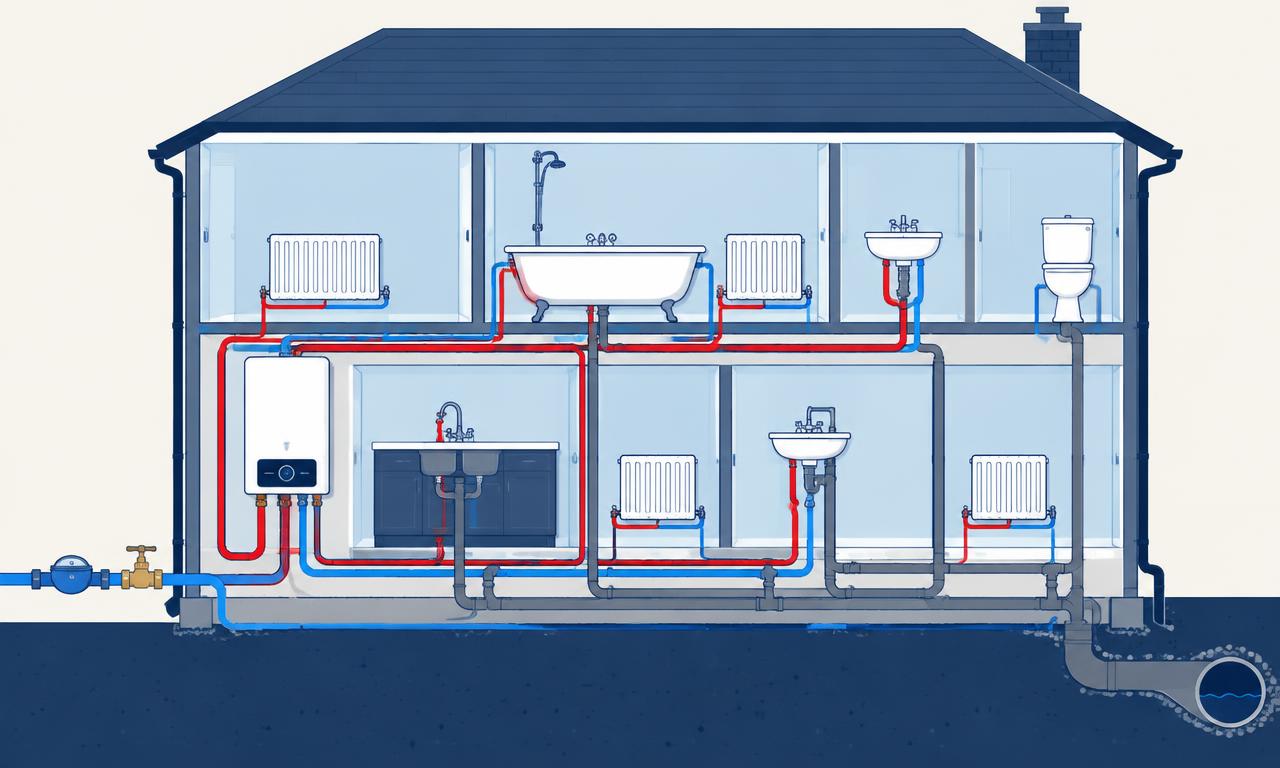
Water comes from the water company's main under the road. It passes a meter and the outside stop tap, then enters the house through the internal stop tap. That's usually under the kitchen sink, in a downstairs toilet or by the front door. Finding it is always the first thing you do on any job.
Why it works this way
The internal stop tap is the master control for the whole house: close it and every cold tap, toilet and combi boiler feed stops, along with a water tank if the home has one. Mains water is under constant pressure, so a cut or loose pipe keeps pouring until the supply is shut off. The pipe from the water company's main up to your property boundary is usually theirs, and the pipe from the boundary into the house is the owner's responsibility. Knowing where the stop tap is and checking it actually closes stops a small leak becoming a flood.
Real job examples
- 1A customer in a 1970s semi-detached house reports a constantly dripping kitchen tap. Your first action is to locate the internal stop tap, which you find in the cupboard under the sink. You close it firmly, open the kitchen tap to release the pressure, then proceed to change the tap's washer.
- 2In a Victorian terraced house, the owner doesn't know where their stop tap is. You check the usual spots and eventually find it hidden behind a plasterboard panel in the hall cupboard. You explain you'll need to cut a neat access hatch so they can use it in an emergency.
- 3You're called to an emergency leak in a new-build flat where water is dripping through the ceiling. You find the stop tap and the water meter together in a utility cupboard. You shut it off and then open the lowest tap in the property (usually the kitchen sink) to drain the system down as quickly as possible.
Common mistakes
- Failing to check if the stop tap actually works before starting a job. You start undoing a pipe and discover the old valve won't close, forcing you to find the outside street tap in a panic.
- Seizing the stop tap by trying to force it shut with a wrench. These are designed to be hand-tightened; using tools can break the mechanism, leaving it stuck open or closed.
You've got it if you can walk into any home and find the internal stop tap within two minutes.
How a pro does it on site
- 1Ask the customer about shared supplies and previous leaks.
- 2Locate the internal stop tap and check for corrosion or dampness.
- 3Gently close it and open a mains-fed cold tap to test whether it stops the flow.
- 4Reopen it, check for leaks and label its location for the customer.
Pro tips
- Not every property has a water meter, and the order of outside fittings varies. Trace the actual supply rather than assuming the layout.
- Never force a stiff stop tap. A broken spindle can leave you with a leak and no working isolation.
- An outside stop tap may serve several homes. Check ownership and contact the water company before relying on it for isolation.
Key words
- Supply pipe
- The pipe bringing water towards the building from the water company's connection.
- Spindle
- The shaft connecting a valve's handle to its working parts.
- Shared supply
- A water supply pipe serving more than one property.
Try this one
A customer in a terraced house wants a kitchen tap replaced. Their internal stop tap will not turn.
Show the answer
Do not force the valve; check whether there is a working local isolation valve. If outside isolation is needed, establish whether the supply is shared and arrange suitable isolation with the water company before starting.